
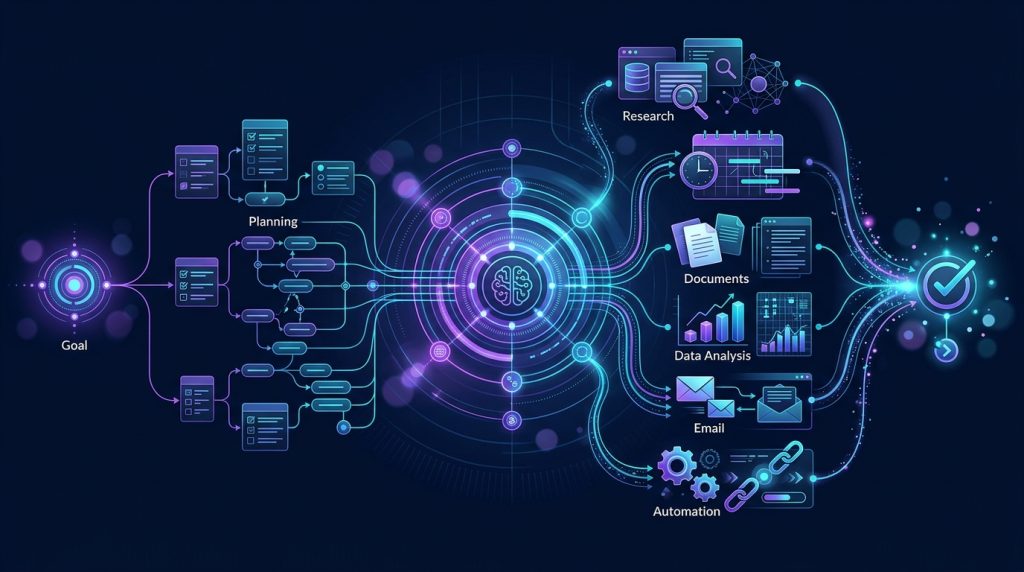
Artificial intelligence has moved beyond simply answering questions. Newer AI systems can plan a task, use software tools, retrieve information, make decisions, and complete multiple steps with less human direction.
These systems are commonly called AI agents.
If you have heard terms such as AI agents, agentic AI, or AI automation but are not sure what they actually mean, this guide breaks it down in simple language.
You’ll learn what AI agents are, how they work, what they can do, how they differ from chatbots, and where they can be useful for everyday work.
What Are AI Agents?
An AI agent is a software system that uses an AI model to pursue a goal, decide what steps are needed, use available tools, and take actions to complete a task.
The important difference is that an agent does more than generate an answer.
For example, a normal chatbot might answer:
“What are the best ways to promote a new blog?”
An AI agent could potentially go further. Depending on the tools and permissions it has, it could research relevant information, organize the findings, create a draft marketing plan, save the plan to a document, and send it for approval.
The exact capabilities depend on how the agent is built and which tools it can access. OpenAI describes agents as systems that use models, instructions, tools, and guardrails to accomplish tasks on a user’s behalf.
Quick Answer
AI agents are AI-powered systems designed to complete goals rather than simply respond to individual prompts.
They can reason about what needs to happen, choose from available tools, perform actions, evaluate results, and continue through multiple steps until the task is completed or human input is required.
That makes them particularly useful for repetitive, multi-step workflows.
How Do AI Agents Work?
A simple way to understand an AI agent is to think of it as a loop:
Goal → Plan → Act → Check → Continue or Finish
Imagine asking an agent:
“Find three suitable meeting times next week and prepare an email suggesting them.”
A basic agent might work through the following process:
1. Understand the goal
The AI interprets the user’s request and identifies what needs to be accomplished.
It may recognize that the task involves checking availability, selecting appropriate times, and preparing a message.
2. Create a plan
The agent determines which steps are necessary.
For example:
- Check the calendar.
- Find available time slots.
- Select three suitable options.
- Draft the email.
- Ask for approval before sending it.
The plan does not necessarily have to be shown to the user. The agent can manage these steps internally as part of its workflow.
3. Use tools
This is one of the most important characteristics of an AI agent.
An agent can be connected to tools such as:
- Web search
- Databases
- Calendars
- Email systems
- APIs
- Spreadsheets
- Code execution environments
- Business software
- File systems
OpenAI’s current agent documentation describes tools as capabilities an agent can use to retrieve information or perform actions, while Google’s documentation describes an agent as combining a model, orchestration, and tools.
4. Evaluate the result
After using a tool, the agent can examine the result and determine what should happen next.
If the calendar tool returns no suitable times, for example, the agent may search for alternative dates instead of immediately stopping.
5. Take another action or finish
The agent continues through the workflow until the goal is reached, a predefined condition is met, or human intervention is required.
This ability to operate across multiple steps is what makes agents different from a simple one-shot AI response.
The Main Components of an AI Agent
Although implementations vary, most AI agent systems involve several important components.
| Component | What it does |
|---|---|
| AI model | Understands instructions and helps make decisions |
| Instructions | Defines the agent’s role, objectives, and constraints |
| Tools | Allow the agent to retrieve information or perform actions |
| Memory/state | Helps maintain relevant information across steps |
| Orchestration | Controls the flow between reasoning, tools, and actions |
| Guardrails | Restrict unsafe, incorrect, or unauthorized behavior |
For example, OpenAI’s current agent architecture packages a model with instructions and optional tools, guardrails, handoffs, and other runtime capabilities.
Not every agent needs every component. A simple agent may only need a model, instructions, and a few tools.
A Simple AI Agent Example
Suppose you run a small online store and receive customer questions by email.
A traditional workflow might look like this:
Customer email → Employee reads it → Employee checks order system → Employee writes response → Employee sends email
An AI agent could potentially handle much of that workflow:
Customer email → Agent understands request → Checks order system → Determines appropriate response → Drafts reply → Requests approval → Sends reply
The agent is not merely generating text. It is connecting the language model to external systems and using information from those systems to complete a task.
For sensitive actions, such as refunds, payments, account changes, or sending important messages, human approval and appropriate access controls can be important safeguards.
AI Agents vs Chatbots vs AI Assistants
These terms are sometimes used interchangeably, but there is a useful distinction.
Chatbot
A chatbot generally responds to user messages.
You ask a question, and it provides an answer.
AI Assistant
An AI assistant can be more capable. It may help organize information, write content, summarize documents, or perform certain actions.
However, the user may still direct most individual steps.
AI Agent
An AI agent is designed to pursue a goal and manage multiple steps with greater independence.
Google Cloud describes agents as more autonomous and goal-oriented than conventional assistants and bots, although the boundaries between these categories can vary between products.
The easiest way to remember the difference is:
Chatbot: “Answer my question.”
Assistant: “Help me do this.”
Agent: “Complete this task within these rules.”
The distinction is not absolute. Many modern AI products combine chatbot, assistant, workflow, and agent features.
What Can AI Agents Do?
AI agents can be used for many multi-step tasks.
Productivity
An agent could help organize information, summarize documents, prepare reports, or manage repetitive administrative workflows.
Customer Support
Agents can classify incoming requests, retrieve customer information, search a knowledge base, and prepare responses.
Research
A research-oriented agent can gather information from permitted sources, compare findings, and organize results into a report.
The quality depends heavily on the tools, instructions, data, and verification process behind the system.
Software Development
Coding agents can inspect code, make changes, run tests, investigate errors, and work through multiple development steps.
Modern agent platforms increasingly support tools, coding environments, and multi-step execution.
Business Automation
Companies can connect agents to internal systems to automate parts of workflows such as document processing, lead qualification, reporting, or support operations.
However, automation should be designed around appropriate permissions and oversight rather than giving an AI unrestricted access to important systems.
What Is Agentic AI?
Agentic AI is a broader term describing AI systems designed to make decisions and take actions toward goals with a degree of autonomy.
An AI agent is one implementation of agentic AI.
The terms are closely related, but they are not necessarily identical.
For example, an agentic system might contain several specialized agents working together. One agent could research information, another could analyze it, and another could prepare the final output.
Microsoft describes agents as systems that can plan, invoke tools, maintain state, and operate with their own identity and permissions, which also introduces additional security responsibilities.
Are AI Agents Fully Autonomous?
Not necessarily.
This is an important point because “autonomous AI” can make agents sound more independent than they actually are.
An agent’s autonomy depends on its design.
A system might require approval before:
- Sending an email
- Making a purchase
- Publishing content
- Deleting data
- Changing account settings
- Executing code
- Modifying business records
Good agent design usually combines automation with appropriate boundaries.
OpenAI’s guidance, for example, emphasizes guardrails and the ability to stop or transfer control when necessary.
What Are the Benefits of AI Agents?
AI agents can be particularly useful when a task has several connected steps.
Potential benefits include:
- Automating repetitive workflows
- Reducing manual work
- Connecting multiple software tools
- Handling tasks that require several decisions
- Maintaining context between steps
- Supporting employees with research and analysis
- Scaling certain operational processes
But more autonomy is not automatically better.
Anthropic notes that agentic systems can introduce additional latency, cost, and complexity compared with simpler workflows. For straightforward tasks, a normal AI response or predefined workflow may be the better solution.
What Are the Limitations and Risks?
AI agents can make mistakes.
An agent may misunderstand an instruction, select an inappropriate tool, rely on incorrect information, or take an unintended action.
There are also security and privacy considerations when agents can access sensitive data or external systems.
For that reason, important agent systems should consider:
- Limited permissions
- Human approval for high-impact actions
- Clear instructions
- Monitoring and logging
- Data privacy
- Testing and evaluation
- Reliable error handling
- Guardrails around tool use
The more authority an agent has, the more important these controls become.
How Can Beginners Start Using AI Agents?
You do not need to build a complex multi-agent system to understand the concept.
Start with a task that has several repetitive steps.
For example:
Goal: Turn research into a blog outline.
A simple agent workflow could be:
- Receive the topic.
- Search approved sources.
- Collect relevant information.
- Organize the findings.
- Identify missing information.
- Create an outline.
- Return the result for human review.
The key is to define the goal, available tools, boundaries, and approval requirements before giving the system permission to act.
If you are interested in building agents yourself, current platforms such as the OpenAI Agents SDK provide tools for defining agents, connecting tools, handling orchestration, and managing guardrails.
The Bottom Line
AI agents are best understood as AI systems that can pursue goals through multiple steps, use tools, make decisions, and take actions within defined boundaries.
They are more than ordinary chatbots, but they are not magical autonomous employees either.
The most useful agents are usually built around a specific problem: researching information, handling support requests, analyzing data, automating repetitive work, or assisting with software development.
For beginners, the most important idea is simple:
A chatbot gives you an answer. An AI agent can work through a task.
As agent technology develops, understanding how these systems work—and where human oversight is still necessary-will become increasingly useful for anyone working with AI.
FAQs
What is an AI agent in simple terms?
An AI agent is an AI-powered software system that can work toward a goal by deciding what steps to take, using connected tools, and performing actions instead of only returning a single response.
How do AI agents work?
AI agents generally interpret a goal, plan or select the next step, use available tools, evaluate results, and continue until the task is completed or human intervention is required.
What is the difference between AI agents and chatbots?
A chatbot primarily responds to conversations. An AI agent can manage a multi-step task and interact with external tools or systems. The distinction can vary depending on how a particular product is designed.
Can AI agents use the internet?
Some AI agents can access web-search or browsing tools, but internet access is not automatically available to every agent. It depends on the tools and permissions provided by its developer.
Are AI agents safe?
AI agents can be useful, but safety depends on their design, permissions, data access, monitoring, and safeguards. Agents with access to sensitive systems should have appropriate restrictions and human oversight.
Can AI agents replace employees?
AI agents can automate parts of some jobs and workflows, but that does not mean they can reliably replace entire roles. Their usefulness depends on the complexity of the work, quality of the underlying systems, and level of human supervision required.
Can beginners build AI agents?
Yes. Beginners can experiment with agent-building platforms and SDKs without creating an entire AI system from scratch. Starting with one narrow, well-defined task is usually easier than attempting a complicated multi-agent system.
What are examples of AI agents?
Examples include research agents, coding agents, customer-support agents, data-analysis agents, scheduling agents, and workflow automation agents. Their actual capabilities depend on the tools and permissions they have.
Conclusion
AI agents represent an important shift from AI that simply responds to AI that can participate in multi-step workflows.
The technology is especially useful when a task requires planning, tool use, decisions, and actions across several stages. At the same time, agents introduce new concerns around accuracy, privacy, security, cost, and control.
For beginners, the best way to understand AI agents is not to focus on the hype. Focus on the workflow: what is the goal, what decisions are required, what tools are available, what actions can be taken, and where should a human remain in control?
That framework makes AI agents much easier to understand—and much easier to use responsibly.


